
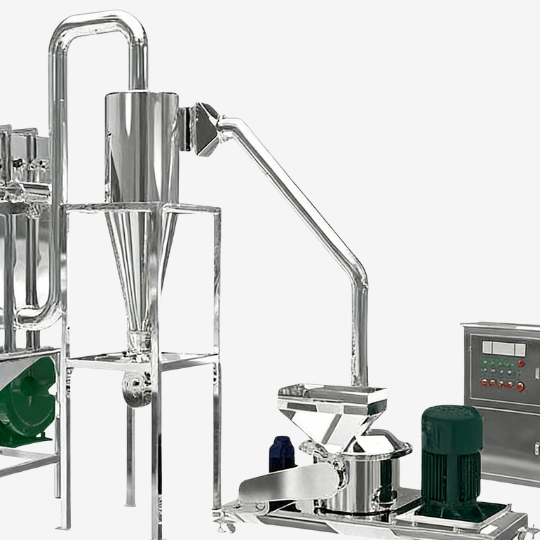


FANQUN Ultrafine Grinder
FANQUN provides ultra-fine grinding equipment for efficient production, meeting your processing needs across different fineness levels, material properties, and production capacity stages.
- Covering diverse production capacities from R&D to mass production, enabling seamless transition of different operations.
- Handle processing brittle, high-hardness, heat-sensitive, viscous, and high-purity materials to meet your abundant process requirements.
- Achieves controllable particle size distribution (80–400 mesh) through variable-frequency speed control and adjustable classification impellers.
- Support for customized ultra-fine grinding solutions based on your material properties, industry requirements, and target particle size.
- Provide comprehensive technical support throughout the entire process, including equipment selection, installation, commission, operation training, and others.
CWFJ series Ultrafine Grinder
The two model grinders consist of three parts i.e. main machine, auxiliary machine and electric control. Its features are compact in design, reasonable in structure. Its principle is using air to choose and no sieve or screen. Being installed grading mechanism inside the machine, the crushing and grading can be finished at the same time. The transportation under negative pressure makes heat produce from the chamber continuously when crushing. Therefore it can also be suitable for crushing thermal sensitive raw materials. The scope of application of machine is wide. Its productive process is continuous and its size of granule can be adjusted. It can crush and grade many raw materials such as chemicals, foodstuff, medicines, cosmetic, dyestuff, resin, shell materials and so on.
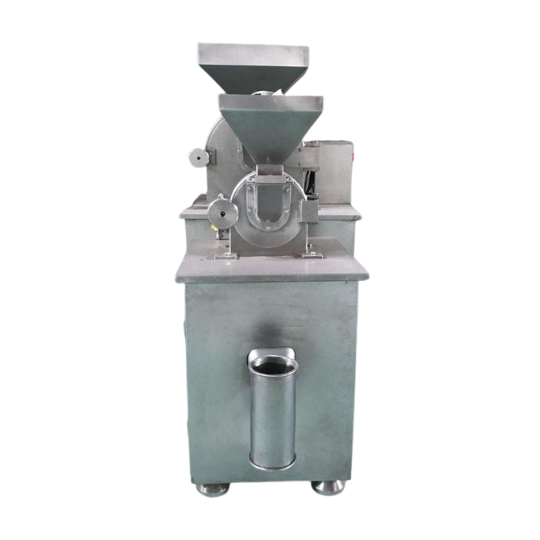
A milling machine with great material grinding, has wide application for chemicals and pharmaceuticals.

Multifunctional and has great advantage to the food industry, has durable exterior and stainless steel hopper.

Great for pulverizing dry goods, has a long lifespan and serves through electricity.
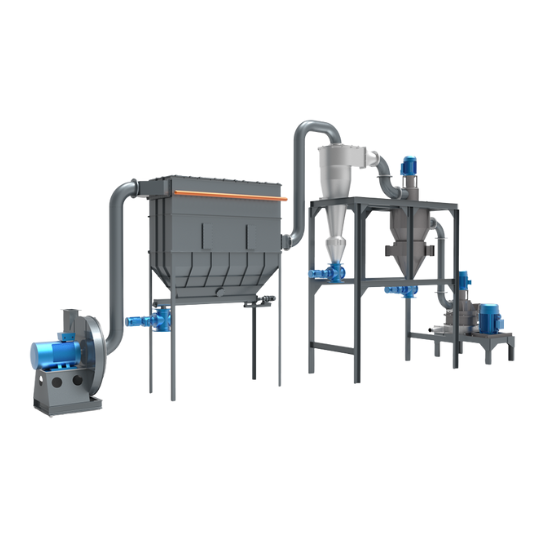
Manufactured with durable materials and easy to operate, multi-purpose on high-efficiency.

Automatic and has a high accuracy rate for food processing and chemical processing. Easy to operate with no delay.
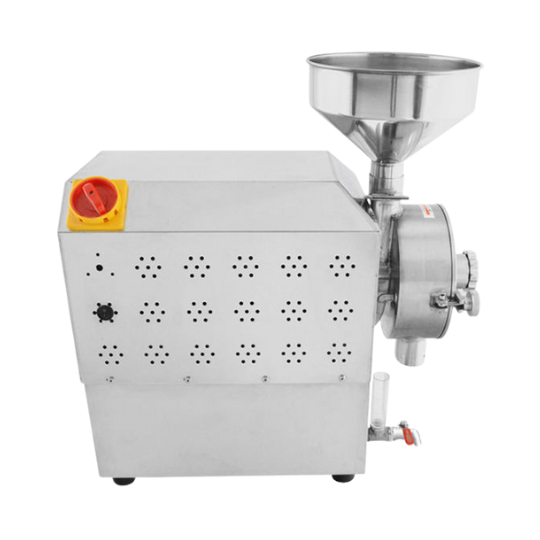
Has a great electric power source and automatic function. Adjustable High-speed control and thickness feature.
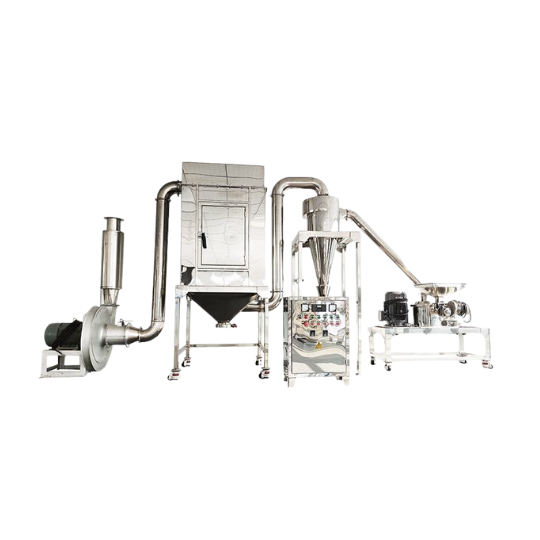
Has universal use and suitable for heat sensitivity, Manufactured with combined function from fine grinding to separation.
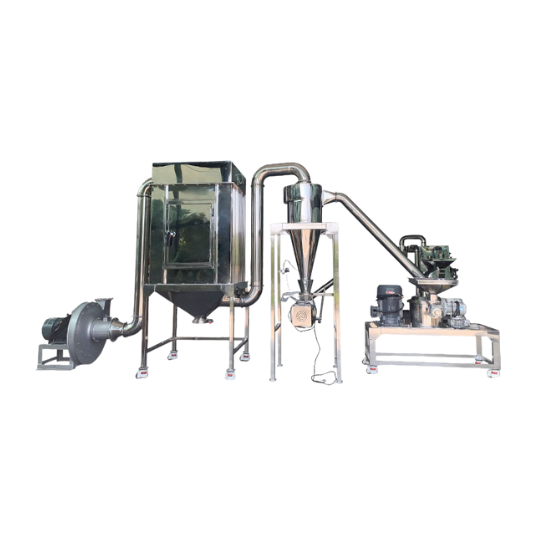
High productivity manufactured with durable stainless steel and has speed control for production control.
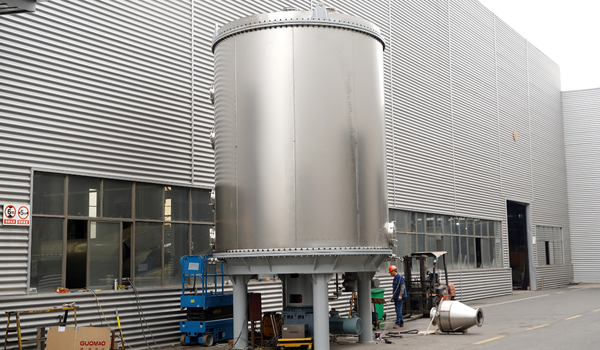
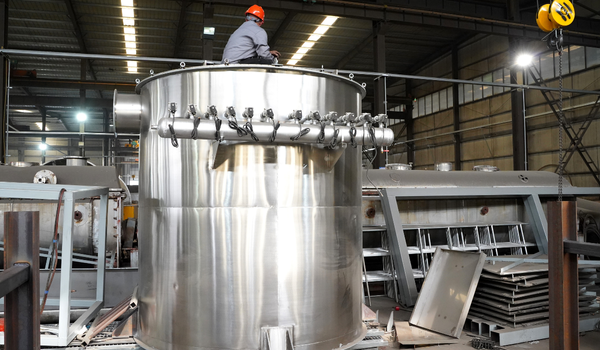
- Our Factory
- Technical Parameters
| Specification and model | Productive capacity (kg/h) | Diameter of materials inlet (mm) | Diameter of materials outlet (mesh) | Total power (kW) | Main revolution (rpm) | Overall dimension (L×W×H mm) |
|---|---|---|---|---|---|---|
| WFJ-15 | 10–200 | < 10 | 80–320 | 13.7 | 4500 | 5410×1660×2500 |
| WFJ-18 | 20–450 | < 12 | 80–450 | 19.07 | 4480 | 5500×1800×3100 |
| WFJ-36 | 60–1000 | < 15 | 80–450 | 38.85 | 4000 | 9000×2200×4000 |
| WFJ-36 | 1000–1500 | < 18 | 80–450 | 65.2 | 4000 | 9000×2700×5280 |
| CWFJ-15 | 10–200 | < 10 | 120–1400 | 18.67 | – | 5510×2130×3115 |
| CWFJ-18 | 20–450 | < 12 | 120–1400 | 31.7 | – | 5800×2500×3500 |
| CWFJ-36 | 60–1000 | < 15 | 120–1400 | 48 | – | 9000×2800×4000 |
| CWFJ-36 | 100–1500 | < 18 | 120–1400 | 76.7 | – | 9000×3000×5280 |
Working Principle of Ultrafine Grinder
The equipment achieves ultrafine particle size grinding through high-energy impact or collision with precise gas-solid classification. During the entire process, the equipment will strictly control the temperature rise of the materials and reduce the risk of agglomeration to avoid the destruction of active ingredients or physical properties due to heat accumulation.
Crushing: The main unit inputs energy at high speed to break down the molecular forces between the material particles and rapidly crush them to the classifiable range.
Classification: It realizes precise separation of particles of the target size by a variable-frequency adjustable classification wheel. Coarse particles are automatically recirculated for re-crushing to avoid overcrushing, while ensuring a narrow particle size distribution and stable and consistent products.
Types of Ultrafine Grinder
Air Flow Ultrafine Grinder
The air-flow ultrafine grinder uses high-speed gas flow (approximately 300-1200 m/s) to push continuous collision, impact and shearing between particles. It is a non-contact pulverization method that can significantly reduce metal contamination. At the same time, its grinding temperature rise is extremely low, usually less than 30℃, suited to grinding heat-sensitive and active materials. However, compared with the impact one, it requires higher energy consumption to make it more suitable for mass production.
If you attach great importance to the cleanliness level of the equipment or if the materials are prone to oxidation and decomposition, it is recommended to choose an air-flow ultrafine grinder.
Impact Ultrafine Grinder
The high-speed rotor drives the hammer head or blade to lead the material to be constantly impacted and sheared in the cavity, achieving rapid crushing. The equipment can produce continuously and stably, processing 50 to 1000 kilograms of materials per hour, which far exceeds the processing capacity of air flow. And it has a simple structure to show lower cost and easier operation. It can achieve a fineness of 10 μm, but usually cannot reach the ultra-fine level of air flow.
The impact ultrafine grinder is an economical choice for you to achieve mass production.
Grinding Ultrafine Grinder
The grinding ultrafine grinder further refined the particles by the rolling, impact and shearing of grinding media such as steel balls, ceramic balls, diamond balls in the cavity. Its fineness can stably reach 0.1μm (nanometer level). And this machine can also handle high-hardness materials, especially suitable for industries such as functional materials, metal powders, and high-end coatings. However, it needs energy consumption more than three times that of the impact type.
Low-temperature Ultrafine Grinder
The material is cooled to the embrittlement temperature from -50℃ to -196℃ by liquid nitrogen or refrigerant to reduce its toughness and viscosity, and then subjected to air flow or impact crushing. This equipment is more suitable for heat-sensitive, oily, viscous or highly tough materials.
If you are seeking to process resins, plastics, spices, bioactive substances or high-fat materials, the low-temperature ultrafine grinder is your ideal choice which can effectively improve product quality.
Main Parts of Ultrafine Grinder
Feeding Hopper
The hopper is responsible for evenly and stably storing the materials. It is usually made of stainless steel to ensure good wear resistance and service life when handling highly abrasive materials.
For materials sensitive to metal ions, you can choose all-ceramic or coated hoppers to further reduce the risk of contamination.
Fan
The fan is used to provide and maintain the airflow required by the system, enabling the crushed materials to be smoothly conveyed into the classification system and the collection end.
Stable airflow can affect the conveying efficiency of materials, and also relates to the control of temperature rise during crushing and the final particle size performance at the same time. So you need to configure it based on the output, airflow velocity and process requirements when selecting machines.
Classification system
The classification system precisely screens particles through a high-speed rotating classification wheel to control the particle size range of the final product.
If it adopts a variable frequency regulation system, you can quickly adjust the classification speed according to the target particle size, which can reduce overgrinding and improve the consistency of the finished product.
Cyclone separator
The cyclone separator uses centrifugal force to preliminarily separate particles in the gas-solid mixture. This significantly decreases the loss of fine powder and increases your finished products’ yield. It can efficiently separate materials of different particle sizes and densities, and reduce the load on the downstream dust removal system.
Material collection system
Qualified fine powder is centrally output through the collection system, while larger particles will automatically flow back to the crushing chamber for further crushing until the requirements are met. This closed-loop circulation design helps you to increase the yield, reduce rework, and provide particle size stability during long-term production.
Control Panel
The control panel is used to manage the entire crushing process, including the main machine speed, the speed of the classifier wheel, the air flow rate, temperature control parameters, and so on.
In real production, a clear interface and intuitive status display enable your operators to complete equipment debugging more quickly and monitor key process parameters in real time during production to improve production efficiency and stability.
Safety device
To ensure your safety during the production process, the ultrafine grinder is usually equipped with overload protection and emergency stop buttons.
If it is flammable and explosive materials, explosion-proof devices will also be installed to ensure your safety and reliability in production.
Auxiliary system
Dust collector: It is used to recover fine powder, particularly suitable for high-value materials. Common types include cyclone, bag and pulse dust collectors. A suitable dust removal system can reduce your material loss and also help meet industry dust emission standards.
Heat exchanger: In air flow or impact ultrafine grinder, heat exchangers can lower the temperature rise of materials to protect the properties of heat-sensitive materials. This is particularly crucial for your materials with high oil content, prone to oxidation or strong active ingredients.
CIP cleaning system: For industries such as food and pharmaceuticals, you can select automatic or semi-automatic CIP cleaning designs to achieve rapid cleaning, reduce downtime and meet GMP hygiene requirements.
Advantages of Ultrafine Grinder
High Precision
The ultrafine grinder can adopt a high-speed impact or gas-solid classification structure to make the material stably achieve an ultrafine particle size of D97 < 10 μm. Its uniform particle size distribution enables you to achieve better process stability in subsequent processes such as mixing, tabletting, sintering or diffusion.
Controllable Fineness
Both the main motor and the classifier wheel are controlled by frequency conversion, which realizes the particle sizes’ rapid adjustment range from 80 mesh to 40 mesh according to the product.
Quick Switch
Even when handling products with multiple specifications or switching materials frequently, adaptation can be completed quickly without replacing core components, minimizing downtime.
Closed Crushing Environment
The machine finishes crushing and classification both in a closed cavity and is equipped with a pulse dust removal system, making the dust leakage throughout the process almost zero. It is particularly suitable for scenarios with high cleanliness requirements such as food, medicine, and chemical additives.
High Yield Rate
The optimized classification system provides more concentrated particle size and more thorough separation of coarse and fine powders, with the finished product qualification rate stably exceeding 99%. This can lower your rework rate and stabilize the process output of the entire production line.
Widely Application
Ultrafine grinding machines are widely used in the food, pharmaceutical and chemical industries. It can handle a wide range of products, including mineral powders, plastic masterbatches, Chinese medicinal materials, herbs, spices, food, pigments, additives, medicines, metal powders, and functional materials.
Easy to Clean
Every main unit is designed with cleaning openings and its module can also be quickly disassembled and assembled, making material replacement and cleaning more easy.And it supports water washing, alcohol cleaning or compressed air purging as your need to reduce the risk of cross-contamination.
Low Energy Consumption
Under the premise of meeting the fineness requirements, the ultrafine grinder’s energy consumption per unit output can be effectively reduced through its optimized design. Compared with traditional crushing equipment, it can save 10% to 20% of energy consumption costs to help you decrease long-term operating expenses.
Technical Specifications of Ultrafine Grinder
| Type | Grinder | Primary Material | 304、316L |
| feeding size(mm) | 0 – 15 mm | Application | Pharmaceuticals, Food, Chemicals |
| Voltage | 110/220/380/480 V | Drying time | Upon model |
| Range of Spindle Speed(r.p.m) | 2800 – 5800 r.p.m | machinery test report | Provided |
| output size | 80 – 400 mesh | Warranty | 1 year |
| output (kg/h) | 20-1000kg/h |
Considerations for Ultrafine Grinder
Material Properties
The hardness, moisture content, and corrosiveness of materials directly impact your equipment selection. It is recommended to clear material characteristics before choosing the most suitable equipment.
For example, materials with high moisture content or prone to sticking may require cooling systems, low-temperature grinding modules, or pre-drying processes to prevent material adhesion, clumping, or adverse effects on particle size distribution.
Feed Size
Grinding efficiency and energy consumption are closely related to feed particle size.
When raw material particle size is large, it is always necessary to add coarse grinding mills, crushers, or screening equipment upstream. This ensures uniform and stable particle size of your material entering the ultrafine grinding stage, preventing overload, elevated temperatures, or fineness fluctuations in the ultrafine grinding mill.
Target Particle Size
Different grinding methods have significant differences in achievable particle size ranges, particle size distribution, and temperature rise control.
If your target particle sizes below 10 μm or higher precision ultrafine powders, it is advisable to choose grinding ultrafine grinder equipped with dynamic classification systems.
Production Capacity
The machines’s capacity should be evaluated based on your process cycle time, shift output targets, and continuous or batch production mode.
If you have plans for future capacity expansion, please select equipment capable of upgrading classification systems, replacing rotors, or adding parallel units.
Ultrafine grinder can easily accommodate diverse material processing requirements and also delivers consistently controlled particle size output during prolonged running while achieving high-efficiency, energy-saving production performance.
As a professional supplier of ultrafine grinding equipment, FANQUN is committed to providing reliable powder solutions across industries. Whether you face challenges in particle size control, quality stability, or production capacity expansion, we offer practical support through specialized equipment and comprehensive services.
Ultrafine grinder is usually suitable for brittle and low to medium hardness solid materials, such as chemical raw materials, food additives, Chinese medicinal material powders, mineral powders, metal oxides and so on.
If your material has a high moisture content, strong viscosity or is prone to oil precipitation during processing, it is necessary to configure a cooling system, low-temperature grinding module or pretreatment equipment to ensure grinding efficiency and stable particle size distribution.
Common vulnerable parts include hammer heads, liners, impellers, classifier wheels and wear-resistant components inside the crushing chamber. Its service life is affected by the hardness and purity of the material as well as the operating load of the equipment, generally ranging from 6 months to 2 years.
It is recommended for you to choose higher-grade wear-resistant materials to extend the service life when needed to handle high-hardness or high-purity materials.
No shutdown is required. Most ultrafine pulverizers equipped with classification systems support online fineness adjustment. You can achieve particle size changes by adjusting the speed of the classification wheel through frequency conversion, controlling air volume and air pressure, and adjusting the feeding speed.
This method can quickly respond to the requirements of process switching without shutting down the machine, reduce downtime losses and improve the stability of the production line.