
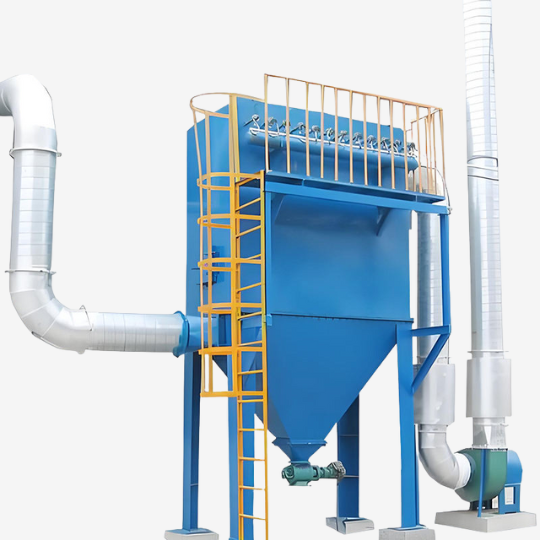
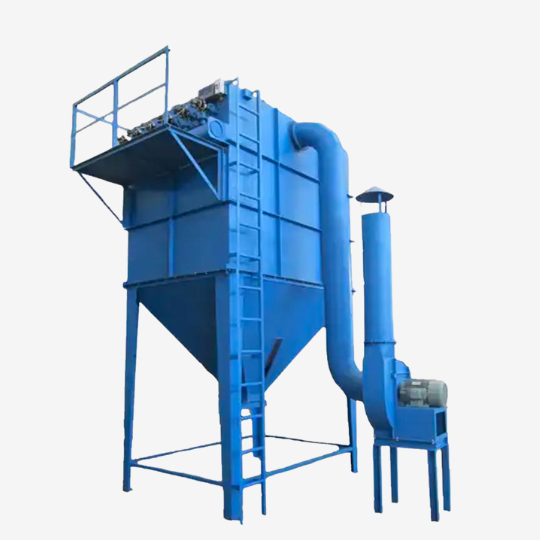
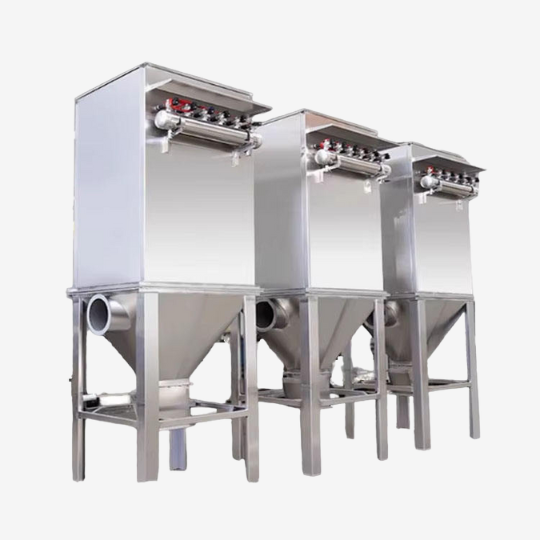
Features of Baghouse Dust Collector
Baghouse dust collectors achieve approximately 99.9% dust removal efficiency, handling dust particles of various materials and sizes. This enables their use across sectors, including metalworking, cement production, food manufacturing, and pharmaceuticals.
- The baghouse dust collector achieves over 99.9% efficiency in capturing sub-micron particles.
- The robust steel construction ensures the baghouse dust collector’s durability.
- The advanced pulse-jet cleaning system enhances dust removal efficiency and operational stability.
- Jiangsu Fanqun Drying Equipment Factory possesses over 25 years of experience in baghouse dust collectors.
- Jiangsu Fanqun Drying Equipment Factory is IS09001 certified manufacturer.
MF series Baghouse Dust Collector
Principle of MF series Baghouse Dust Collector
- The air stream containing dust passes through low box from air inlet parts of it deposit when right particle dust floated. It is retarded in the bag. The purified air penetrates the filtering bag and passes into the up box through Venturi tube and exhausts from outlet.
- The accumulated powder dust on the outer wall of filtering bag is increased continuously. If the resistance reaches the limit range (in generally, it should be 80-120mmH₂O), it is necessary to clean the accumulated powder dust. The cleaning method is as follows: controller touches off each control valve in order to make the compressed air inside the gas bag spray out through nozzles (the 1st wind). Using Venturi tube, several times of air around it (the 2nd wind) enters into the bag and makes the filtering bag expand rapidly at momentary and accompany with the counter action of air stream. This makes the dust drop into dust gate and discharge outside the machine.
The equipment is widely used for ventilation and recoverable dust such as metallurgy industry, casting industry, mine, chemical industry, pharmaceutical industry, construction, material industry and grain processing industry and so on.
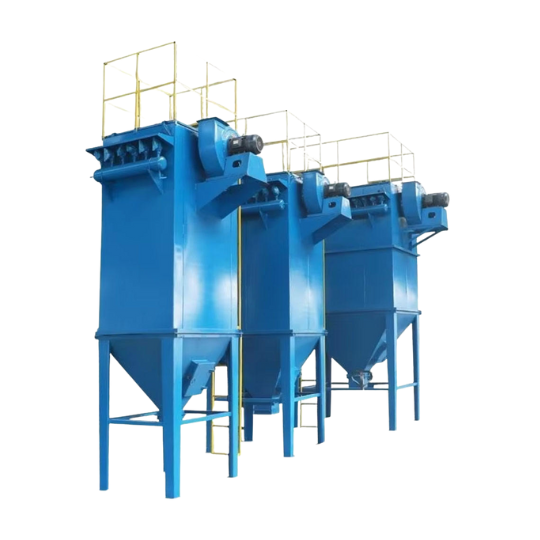
Multiple styles are customizable, Industrial use applications with wide capacity for air filtration and cleaning.
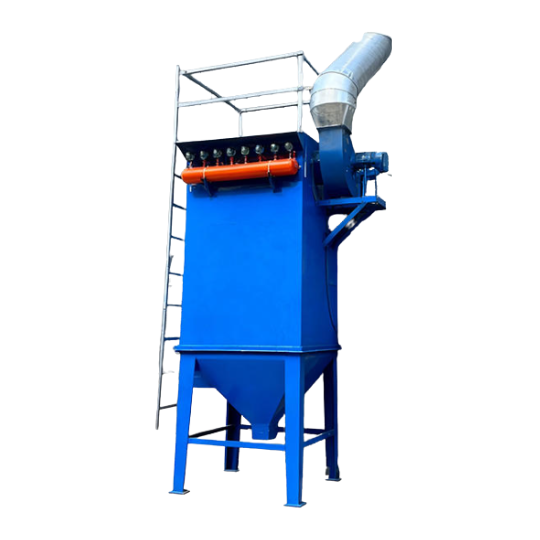
Has longer timer settings with durable build. Removing industrial dust and various applications.
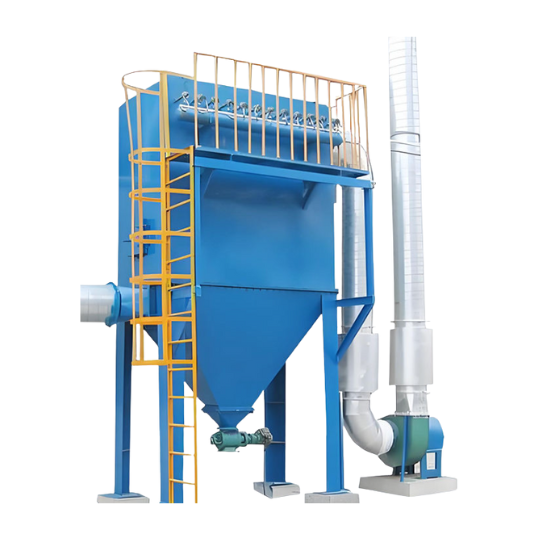
Enhanced filtration and large versatility for customization, No affected ventilation and ensured quality protection.
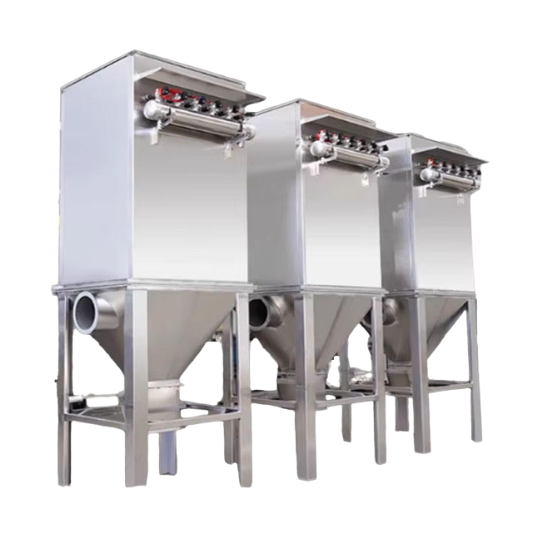
Great efficiency and filter bag for sawdust, High accuracy for filtration and has automatic features with timer setting.
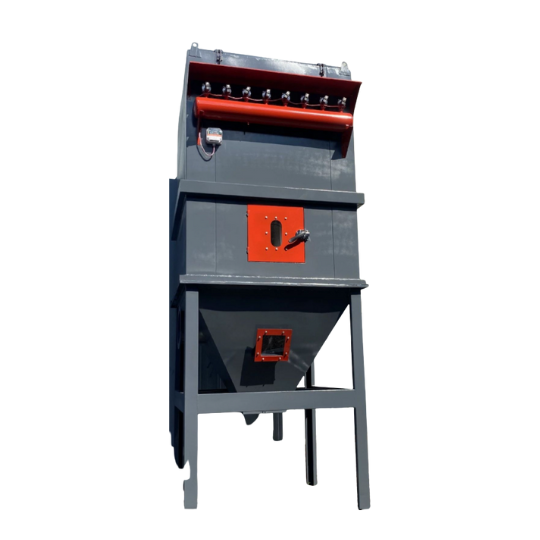
Manufactured with great stability and high dust removal efficiency, Great steel stability suitable for treating flue gas.
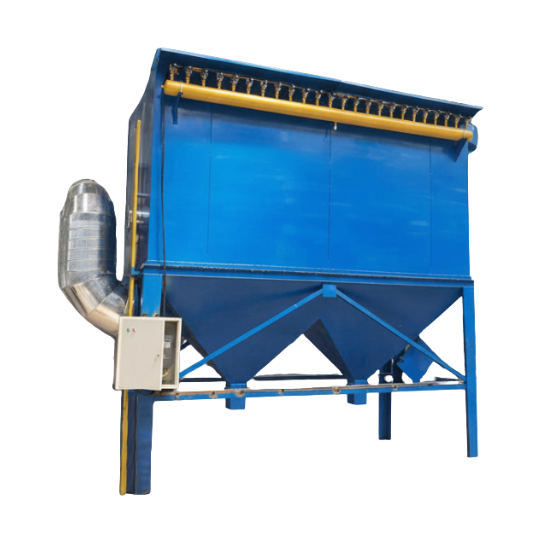
Great top loading and has long timer setting, weight capacity over 90% and great filtering capacity.
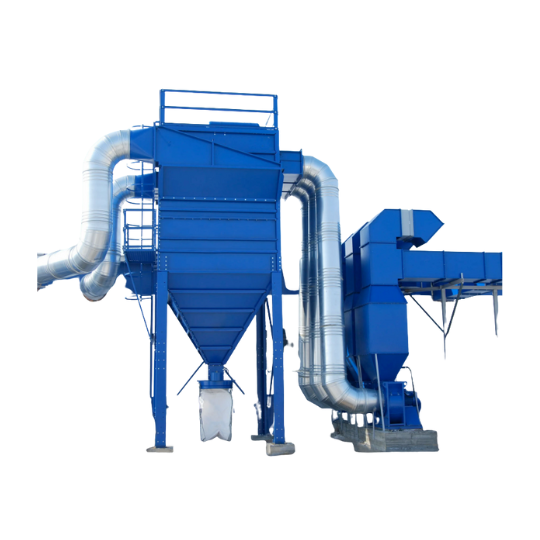
Collector bag with great filtering capacity, adopts domestic high-temperature bag. Has a large application for various operations.
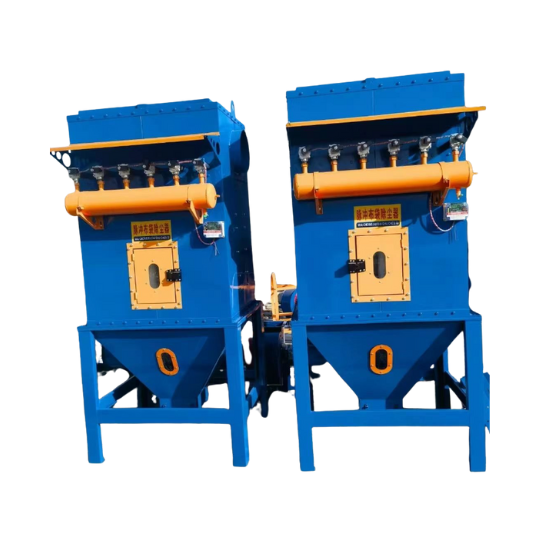
Has great reliability and stability with low gas consumption, Suitable for treating contaminating flue gas with large air volume.
- Our Factory
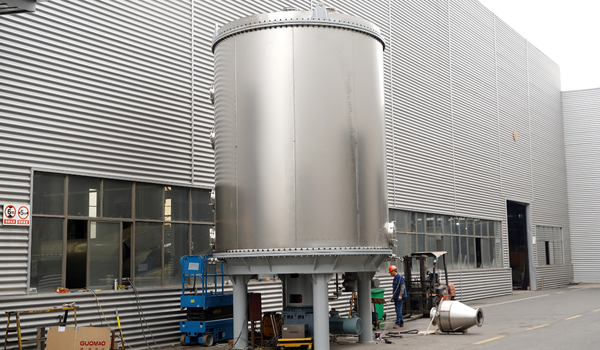
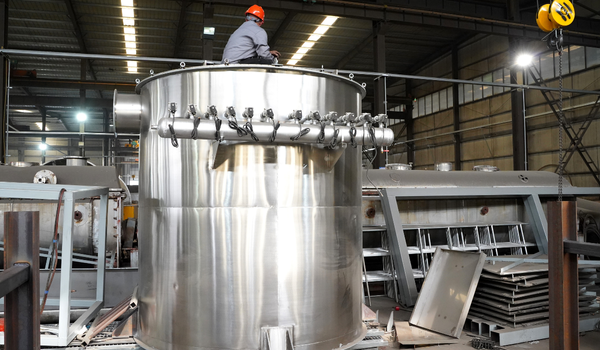
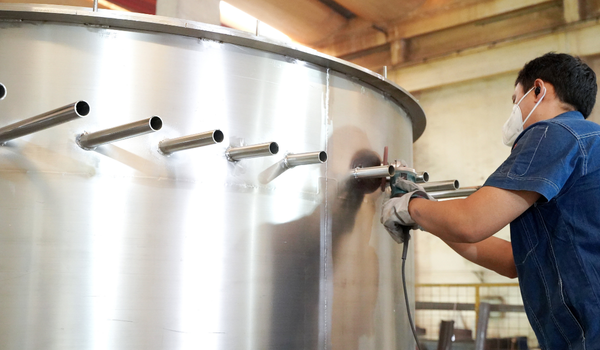
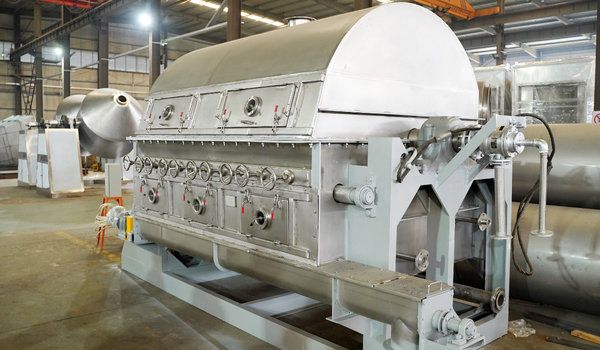
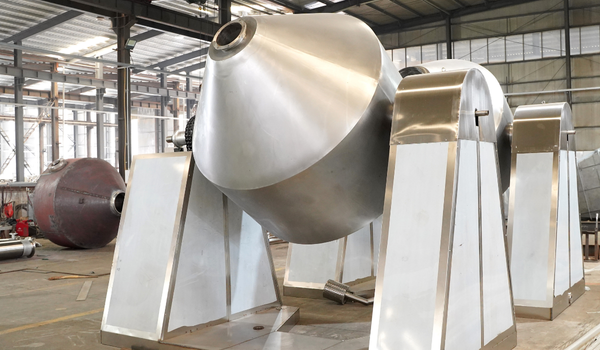
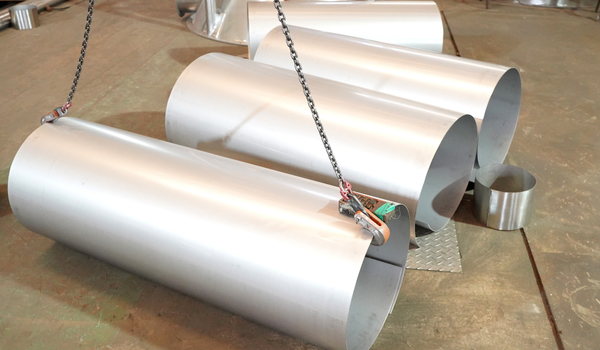
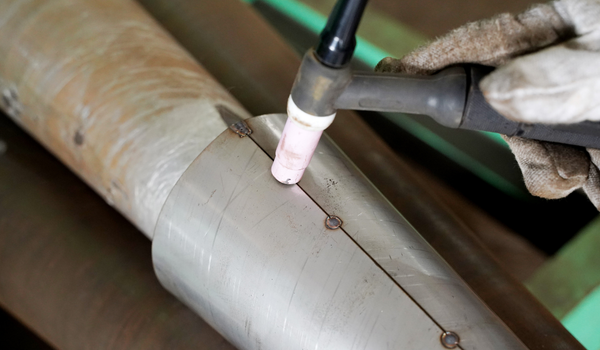
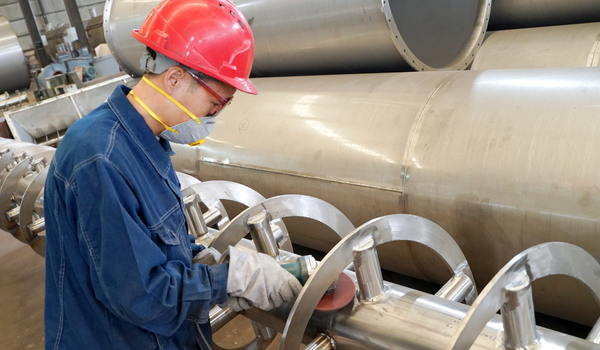
What is the Baghouse Dust Collector?
Baghouse dust collectors are commonly employed for the removal and recovery of dust particles generated during industrial manufacturing processes. They rapidly draw in and filter substantial volumes of industrial dust, returning fresh, clean air to the environment to enhance air hygiene standards. This establishes higher standards of hygiene within your industrial operations and improves worker safety.
Key Components of a Baghouse Dust Collector
Filter Bags
Filter bags are the primary component that enables baghouse dust collectors to function effectively. They separate dust particles from the air stream, trapping them on the inner surface of the filter bags. You may select the filter bag’s dimensions, material and shape according to your application.
Filter Cage
Filter cages are typically constructed from rigid metal to provide enhanced structural support for filter bags. This ensures the filter bags remain open, preventing collapse or blockage.
Hopper
The hopper collects dust retained within the filter bags after the filtration process. It minimises dust blockages, ensuring the stable operation of the baghouse dust collector and preventing recontamination of fresh air with dust particles.
Cleaning System
The cleaning system of bag filters can promptly remove filtered particles during processing, thereby enhancing dust removal efficiency. Various types of baghouse dust collectors are available, including pulse-jet, mechanical shaking, and reverse-air cleaning systems.
Control Panel
The control system for the baghouse dust collector features a user-friendly design, allowing you to start, stop, and monitor the equipment at any time.
Dust Collection Chamber
After being drawn in, the air first enters the dust collection chamber. It pre-separates heavier dust particles from the air before they reach the filter bags, extending the service life of filter bags. The heavier dust particles fall to the bottom under the influence of gravity.
Fan
The fan provides the impetus for airflow. It draws in contaminated air from the external environment, ensuring a smooth inflow. It also expels filtered, clean air.
Discharge mechanism
The discharge mechanism serves to promptly remove accumulated dust from the hopper, preventing excessive dust from recontaminating the air. Small baghouse dust collectors may feature manual discharge, whilst larger units typically incorporate rotary valves or screw conveyors for automated discharge.
How does a Baghouse Dust Collector work?
- Air Intake: It is appropriate to install the bag filter within the industrial pollution control system, positioned within the area where dust is generated. During operation, the collector’s fan rotates at high speed, rapidly drawing contaminated external air into the unit.
- Filtration: Upon entering the unit, air first accumulates in the dust collection chamber, where heavier dust particles are separated. Unseparated dust continues with the airflow towards the filter bags. The contaminated air is forced through the filter bags, separating dust that then accumulates on the inner walls of the bags.
- Cleaning: After processing sufficient contaminated air, a dust layer forms within the filter bags. To prevent subsequent impairment of the baghouse’s performance and efficiency, the cleaning system is activated. This system either flushes or shakes the dust from the filter bags into a hopper at the base.
- Recovery and Discharge: The dust within the hopper can be cleared or recovered for reuse. The filtered, clean air is then discharged into the environment, thereby improving air quality.
Types of Baghouse Dust Collectors
Pulse-Jet Baghouse Dust Collectors
Pulse-jet baghouse dust collectors employ a pulse-jet cleaning system that uses compressed air to impact the filter bags, dislodging dust particles adhering to them. This cleaning mechanism does not interrupt the airflow during filtration, enabling continuous cleaning without requiring shutdown during operation. Consequently, these units deliver exceptional dust removal efficiency.
Reverse Air Baghouse Dust Collectors
Reverse-air bag filters, like pulse-jet bag filters, utilise air for cleaning. However, the dust they filter accumulates on the outer surface of the filter bags, requiring cleaning with a reverse airflow. This method also impacts the filtration process. Consequently, cleaning occurs intermittently, halting filtration during the cleaning phase. If you are seeking a suitable tool for scenarios involving heavy dust removal, this is the ideal choice.
Shaker Baghouse Dust Collectors
Unlike other types, mechanical vibration bag filters do not utilise air. Instead, they rely on mechanical vibration to dislodge dust particles into the bottom hopper. This method causes wear on the equipment and requires greater maintenance, and is gradually being replaced by other types.
Envelope Baghouse Dust Collectors
Thanks to the slender cylindrical filter bag design of the envelope-type bag filter, this configuration enables higher efficiency and the handling of greater dust loads. You may use it in industrial processing operations that generate larger dust particles, such as wood processing and grain handling.
Cartridge Baghouse Dust Collectors
Unlike envelope-type bag filters, cylindrical bag filters also employ cylindrical filter bags, but these bags feature numerous pleats. This design provides a larger filtration surface area while maintaining a compact structure. They are suitable for industrial environments handling finer dust particles.
Advantages of Baghouse Dust Collectors
Broad Applicability
On the one hand, baghouse dust collectors can handle particulate matter ranging from fine, lightweight particles to larger aggregates. On the other hand, they effectively manage troublesome airborne contaminants such as high-temperature particles, flammable particles, toxic particles, and viscous particles. They meet virtually all industrial requirements while achieving 99.9% efficiency.
High Recovery Rate
The collection system of baghouse dust collectors aggregates separated dust particles. This not only prevents secondary dust contamination but also enables the reuse of certain material particles. For instance, in metal processing, it effectively recovers metal particles, thereby reducing costs and minimising resource extraction.
Durability
Baghouse dust collectors are constructed from robust, durable materials to withstand harsh industrial environments. They can endure high temperatures, vibration, humidity and corrosion, thereby reducing maintenance requirements and reduce downtime
Scalability
The Baghouse dust collector can be configured in a modular fashion, making it a flexible and scalable dust collection system. Should dust load or operational requirements change, existing equipment can be readily retrofitted and expanded to enhance capacity and performance without necessitating replacement of current installations. This approach also eliminates the need for substantial initial investment, energy consumption, and maintenance costs.
Baghouse Dust Collector VS. Cyclone Dust Collector
Cyclone dust collectors and baghouse dust collectors are both highly efficient devices for removing dust and purifying air, yet their operating principles differ. This also results in them possessing different dust removal efficiencies and effects.
- Operating Principle: Cyclone dust collectors utilise centrifugal force generated by high-speed rotation to separate air from dust particles. During operation, contaminated air is drawn into the unit, where the rapid rotation causes dust particles to separate from the air stream, thereby cleaning the air.
- Dust Removal Effectiveness: Baghouse dust collectors generally achieve superior filtration by capturing particles ranging from microscopic to larger sizes. They are also capable of handling specialised particles such as sticky or toxic materials. Cyclone dust collectors, however, demonstrate greater efficacy in filtering larger dust particles.
- Dust Handling Capacity: Overall, baghouse dust collectors can manage higher dust processing loads, whereas cyclone collectors exhibit lower efficiency under such conditions.
- Maintenance: Cyclone dust collectors feature a simpler, more compact structure, making installation and maintenance easier. Baghouse dust collectors, however, occupy more space and require greater maintenance.
Jiangsu Fanqun Drying Equipment Factory possesses over 25 years of experience in manufacturing baghouse dust collectors, with products exported to the United States, Japan, and numerous countries worldwide. Should you be seeking high-quality baghouse dust collectors, please do not hesitate to contact us.
Baghouse dust collectors wear with use, making them prone to clogging or leakage. The specific timing varies depending on the type and application, but generally speaking, it is advisable to replace them approximately every 1 to 2 years.
Baghouse dust collectors can be employed in all processing operations affected by dust or material particles, such as metal and woodworking, cement manufacturing, food processing, pharmaceuticals, grain processing, and so forth.
To maximise performance, regular cleaning is required to prevent clogging. Inspect for wear, leakage and damage, and promptly replace and repair components. Additionally, during routine operation, you should continuously monitor the differential pressure.
High pressure differential – You should inspect for leaks, attempt to clear the hopper, or increase the frequency of air purging.
Dust leakage – Inspect the dust collector and adjust the damper to improve the situation.
Insufficient airflow – You should halt operations to look for the filter bags, ducting, and dust collector for blockages, and clear them promptly.